

Marathon Des Sables: The Toughest, Toughest Footrace on Earth
Words From the Shoes That Walked There...
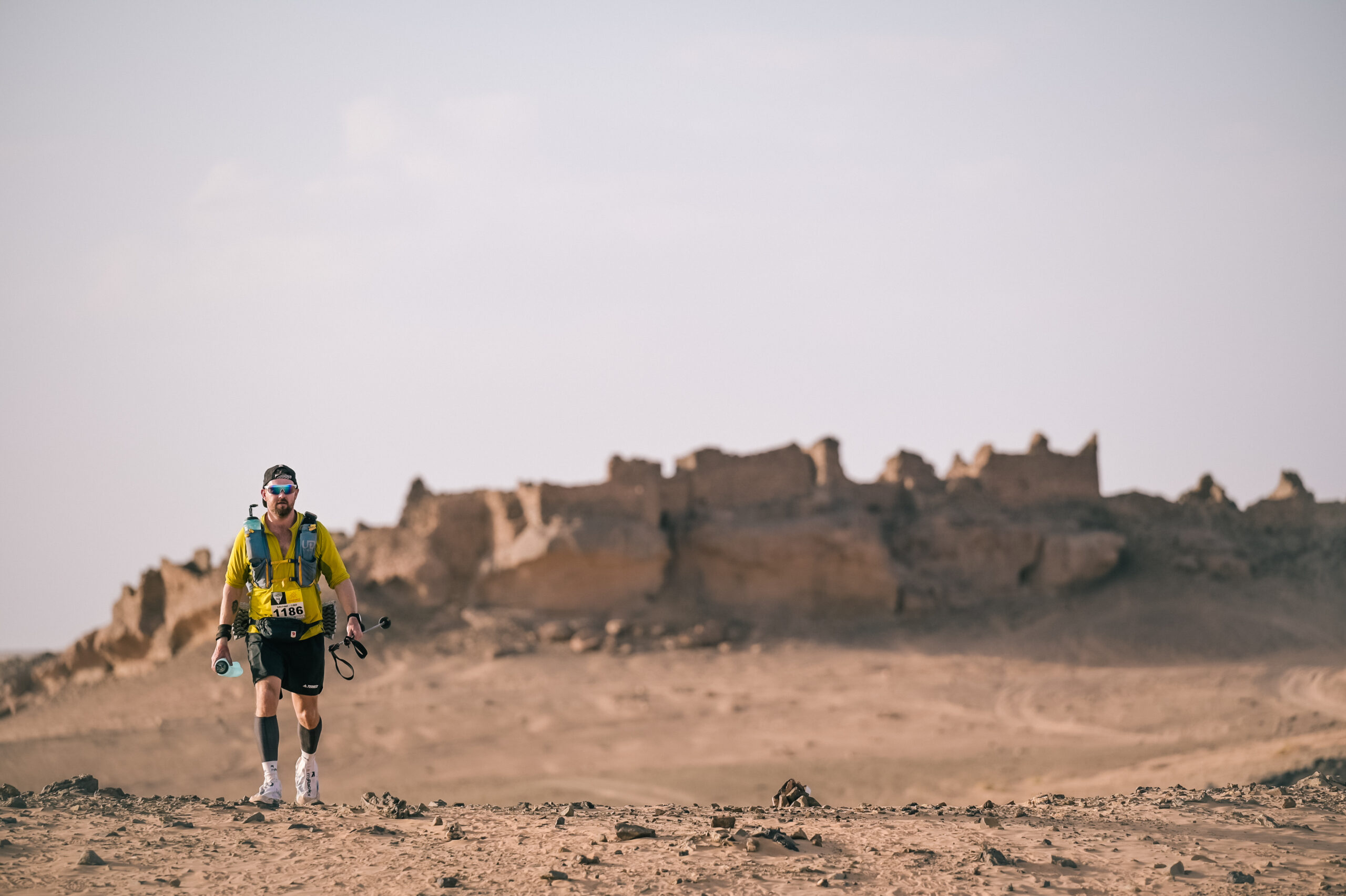
Marathon des Sables
37th Edition – 2023
By Mike Procter
Mid-afternoon, sat by a picturesque swimming pool with some new friends, Alex, Steve and John. We’d only met nine days earlier, but it already felt like I’d known these three guys for years thanks to the incredible bonding experience of the past week. We had just completed the notorious Marathon des Sables (MdS). Here we sat, clean and washed for the first time in a week, in the unexpectedly opulent Berbere Palace Hotel, where we were staying for the two nights after the event.

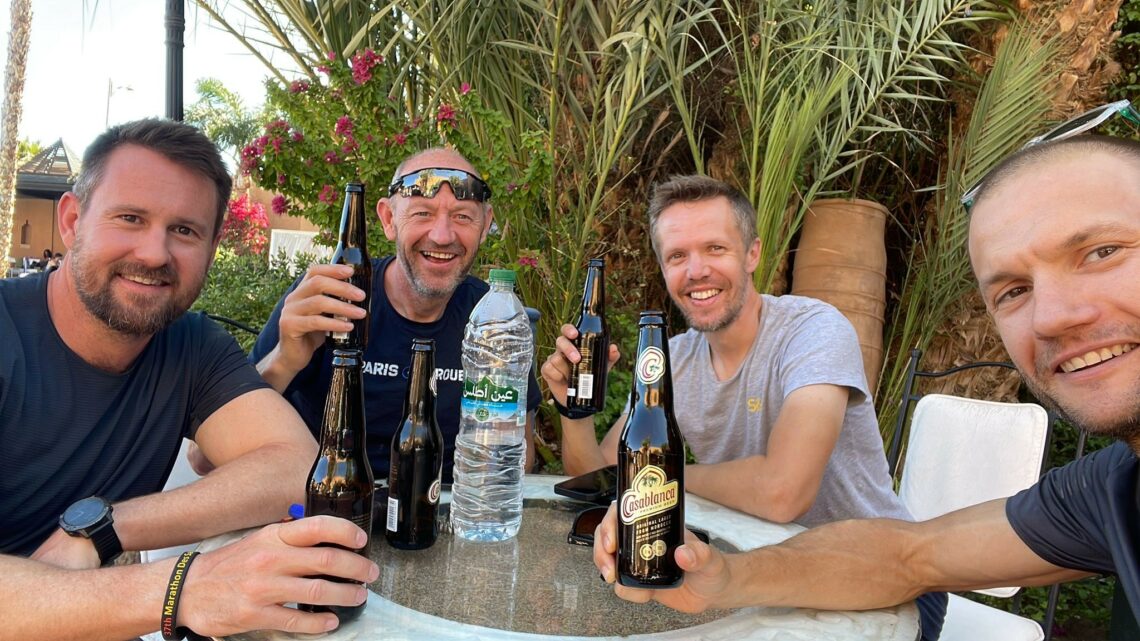
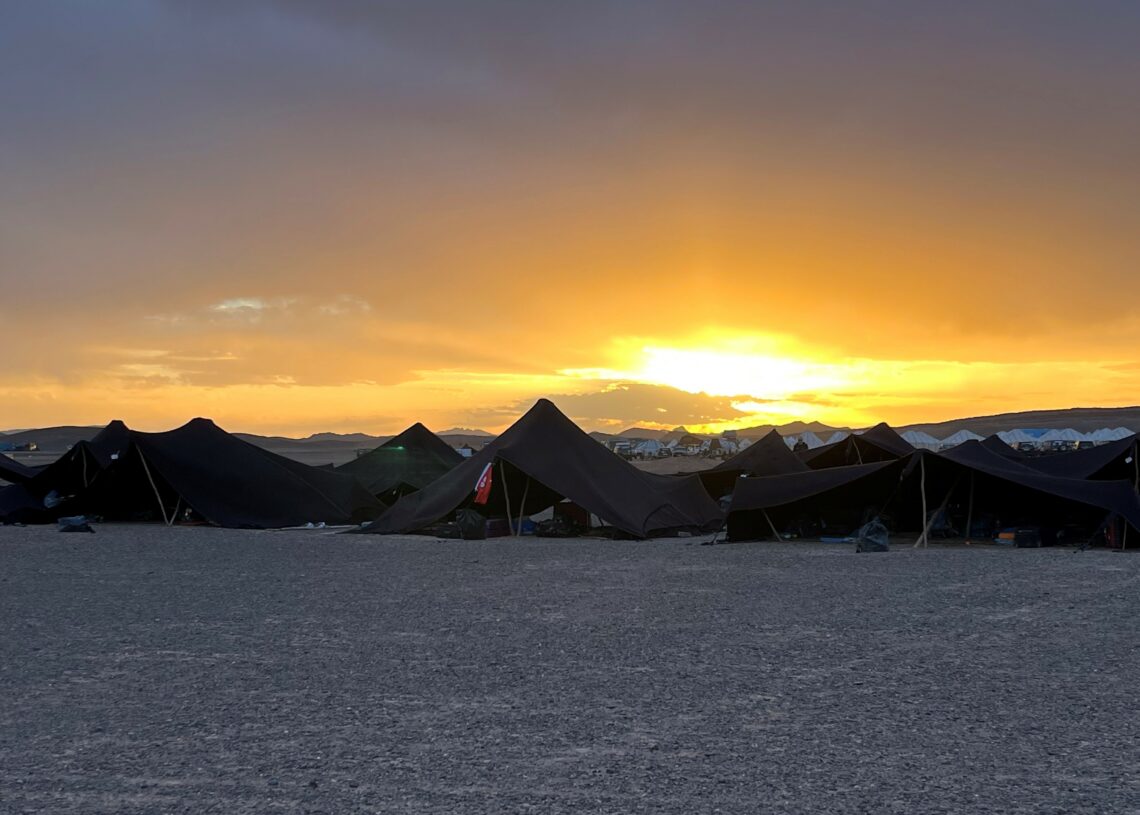
In this serene setting, for our one day of blissful recuperation, we drank our way through bottle after bottle of the local Casablanca lager, as we laughed and recounted our grim, yet strangely entertaining stories of the past week. We had been tent mates through the event. By tent, I mean a large open sided blanket pegged over some sticks. Hundreds of which, in a circular formation, made up the ‘bivouac’ where the race participants were accommodated throughout the race.
We had started with a full tent of eight. So, whilst we sat enjoying the cold beer, we were also saddened to have lost the other four – Tomo, Nick, Stewart and Carl – along the way. Tomo, in particular, being one of my oldest friends. We had signed up to this crazy event together, fully expecting to finish it together.
The Legendary Marathon des Sables
That’s exactly what they call it. In certain circles, it genuinely is the stuff of legend. The race attracts all manner of people, from elite athletes and ultra-marathon runners to determined amateurs seeking a challenge. Military veterans like myself are common. I had first heard of this race years ago, back when I was an Infantry Officer in the British Army.
So, what is it? Put simply, it’s six marathons in seven days across the Sahara Desert. The six stages aren’t broken down evenly. The route changes every year but always follows the same broad format. The first three stages are between 30-40km, before the infamous long stage (90km this year). Then another marathon, which confusingly leads to the finish line (for the timed portion of the race). Then a short, final day (9km); untimed but mandatory to be classed as a finisher.
It’s clearly an ultra-distance event, but to be widely heralded as the Toughest Footrace on Earth, this is about much more. It’s the whole package of gruelling terrain, searing heat, rationed water, carrying all your own kit (including food for the week), whilst living in an open-sided tent, periodically battered by sandstorms.
The race had been on my bucket list for years when Tomo suggested we get on and do it. We’ve been friends since school. Tomo has spent his entire career as a British Army Doctor. He is one of the fittest people I know, and if there was anyone who might share my attitude to this sort of challenge, it was him. Within days, with permission reluctantly granted by our extremely supportive wives, we had signed up.
An Unwelcome Welcome
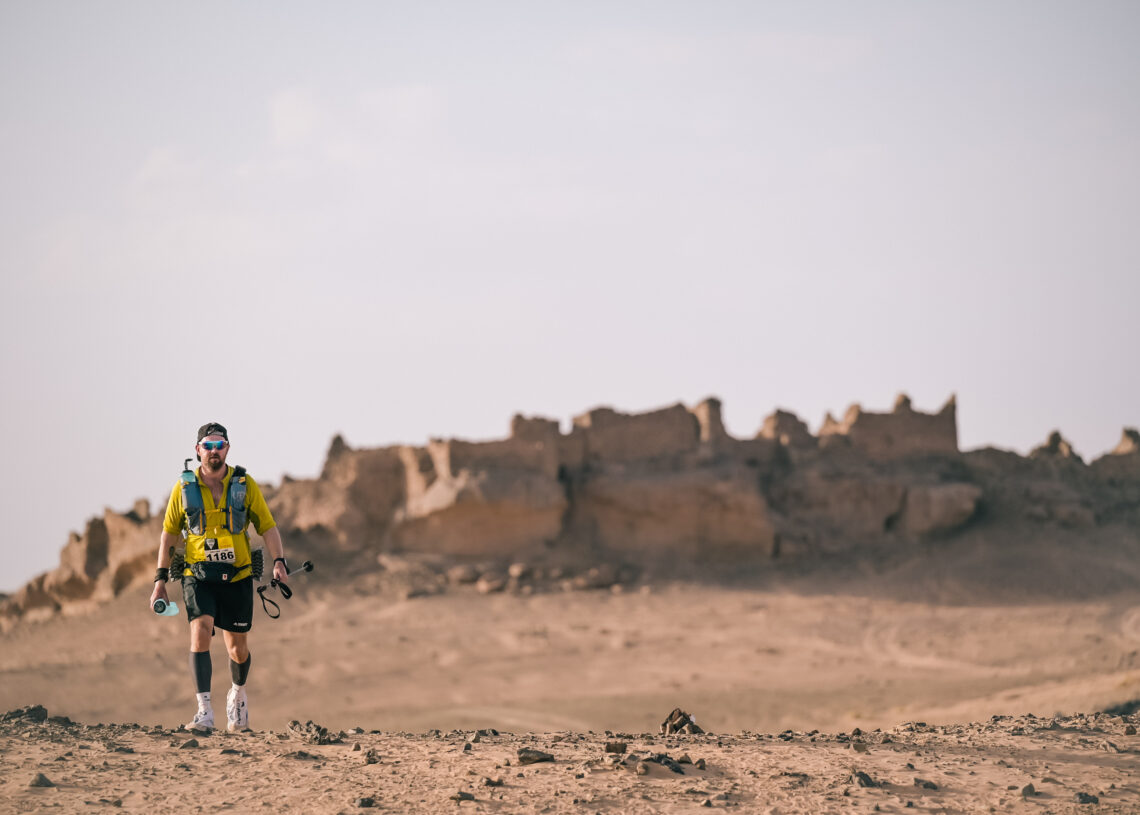
Seven months later, here we were. There was certainly no easing into it. No arrival hotel, just straight to the bivouac. In a fitting welcome to the [translated] Marathon of the Sands, our nervous-looking hoard stepped off the transfer buses straight into a sandstorm!
Within minutes our entire bodies were coated in a film of sand which would stay engrained for the next nine days. Sandstorms, we would certainly get used to, and the tents don’t exactly cope well with them, flapping wildly, dislodging their supports, and ripping their pegs from the ground, whilst occupants would scour the area looking for large rocks for ballast, and Moroccan support staff ran around with mallets trying to peg them back down. Luckily, they tended to be short-lived, and when the dust settled, the evenings were particularly pleasant. The cooler temperatures and the camaraderie of tent life made for some of the best memories of the whole trip. Particularly, as we found, with the awesome group of people we’d been allocated a tent with.
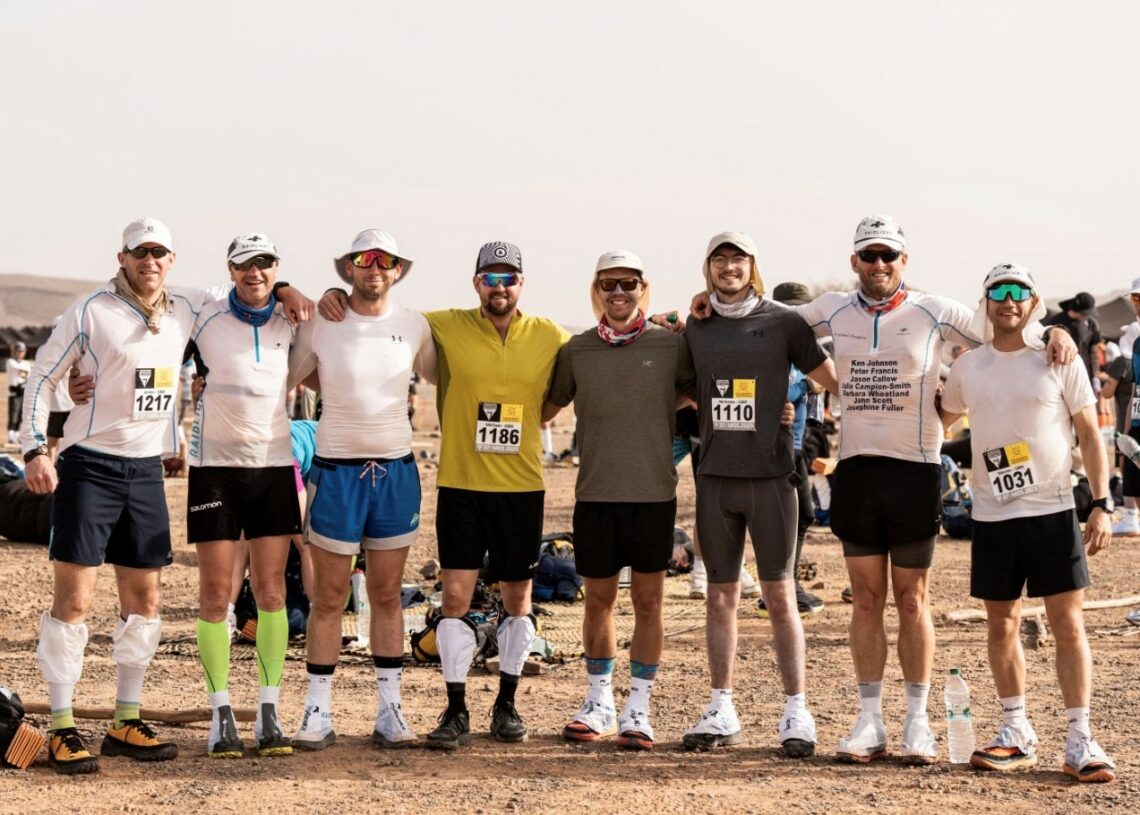
Credi: Marathon des Sables
The pre-race activity was slow to say the least, and mostly involved queuing. The day after arrival was registration and kit-checks. You deposit your luggage not to be seen again until the end. From here on in, you’re wearing your race clothing ready to start, and everything you have, you carry on your back.
This includes mandatory items such as a foil survival blanket, venom pump, signalling mirror, compass, passport, 200 Euros in cash, as well as a sleeping bag, a few spare clothing items, medical kit, and seven days’ food supply. My pack weighed 12kg, 7kg of which was food. At least that would dwindle down through the week.
Officials also issue your SPOT GPS device. Not only so that you can be tracked along the way, but also for calling for help in case of an emergency.
A Tough Start
After a long, slow build-up over two days and nights, there was a nervous energy as we finally gathered at the start line of the first stage. I was excited by the famous MdS tradition of the race starting to the thunderously appropriate soundtrack of AC/DC’s Highway to Hell, with the helicopters swooping overhead.
Tomo and I had a plan, based on our mutual Army experience of tabbing, which involves running along the flats, slowing to a fast march over hills or challenging terrain.
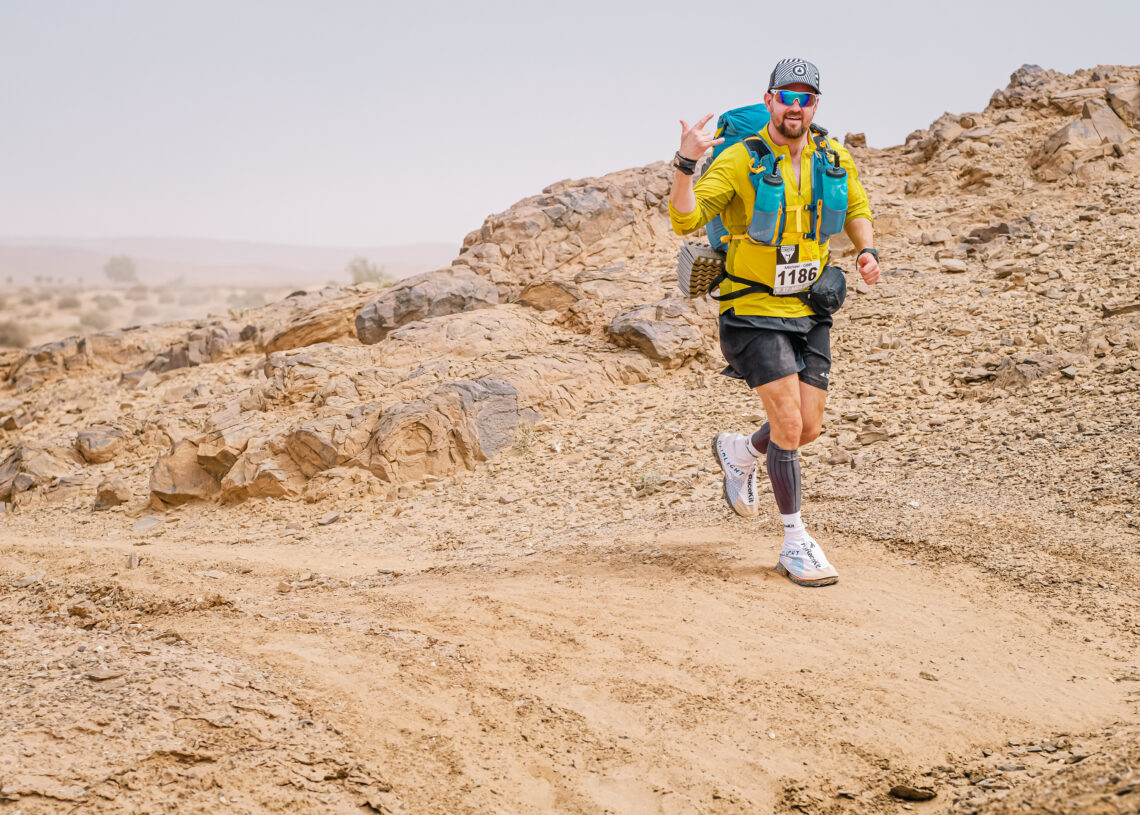
We got through most of the first day like this, making respectable time, finishing in the top 25% of the near-1100 starters. Word around camp, amidst the many race-repeaters, was that this was one of the hardest opening stages they had experienced – longer than usual and testing terrain. This would turn out to be a theme of the week.
The shortest day (stage two, 32km) involved an inordinate amount of climbing, with an extremely tough combination of soft sand and rocky sections, and the ominously long stage four was the second longest in race history, at 90km.
Heat Emergency
In the scheme of things, the challenging route was the least of our problems. The biggest contest was the heat. That might not sound surprising for an event taking place in the Sahara Desert, but the whole region was experiencing what even the locals call a heatwave. According to one of the medics I spoke to – who take temperatures at various points along the route for safety – the peak temperature recorded was 57 degrees.
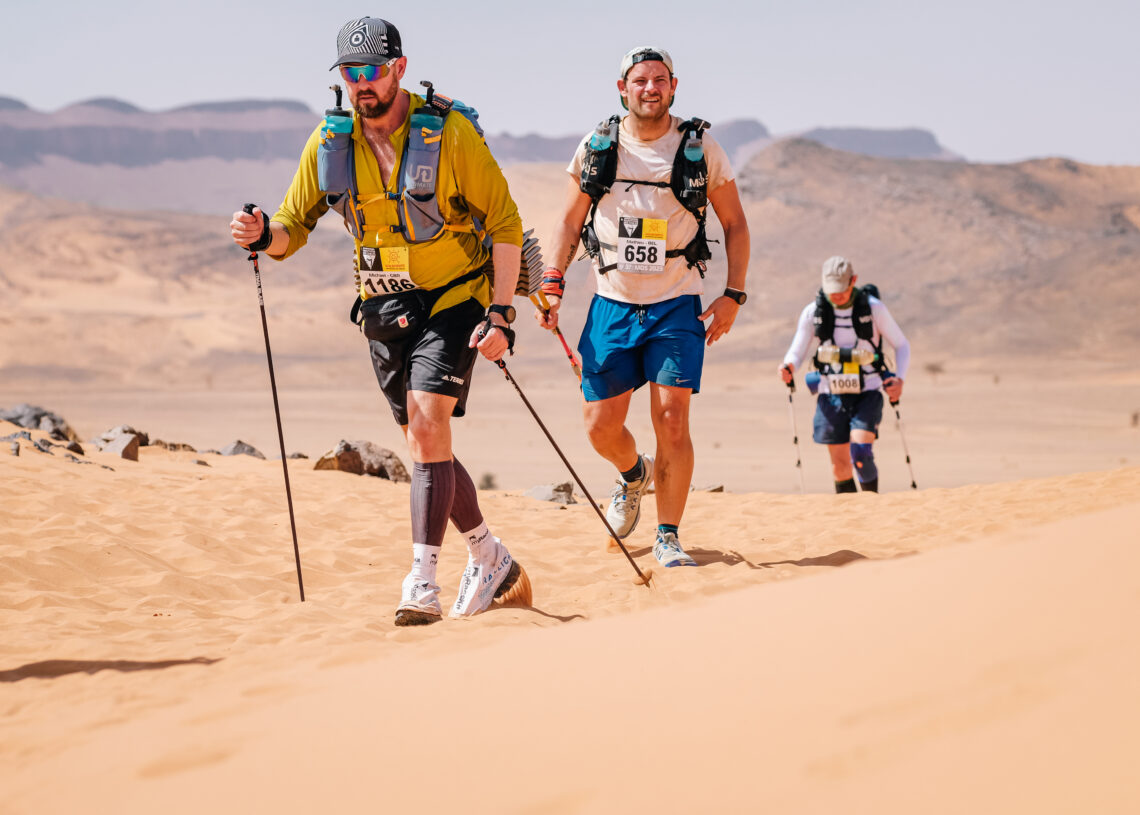
After deciding we had pushed it unsustainably hard on the first day, Tomo and I set about the second stage at a more sensible pace; a consistent, fast march, suitable for a day dominated by big climbs and challenging terrain. As plenty of the field slowed down from their starting zeal, I’m confident this approach would have kept us in or around the top 25%. But the heat and the terrain would still take its toll.
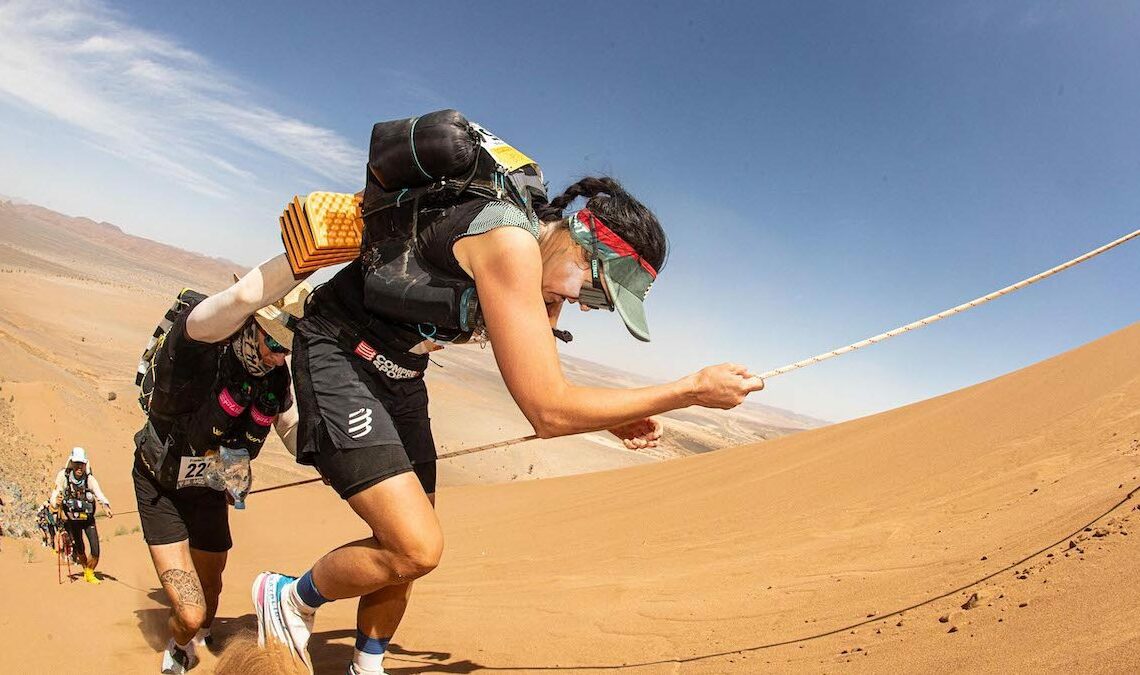
The last energy-sapping climb of the day took us over the dreaded Djebel El Otfal, rising several hundred meters above the desert below, hauling ourselves up a rope though deep sand. Just as we thought we had conquered the last major obstacle of the day, only 3km left to the bivouac, 2km of rolling dunes appeared in our path.
Credit: Marathon Des Sables
Tomo had noticeably struggled over the Djebel. Hitting those dunes in the heat of the day, he went rapidly from bad to worse. At first, he looked a little wobbly. With the help of a passing Brit, we attempted to steady him, holding an arm each side. But that effort was short-lived. Moments later, Tomo collapsed, unconscious, his body in convulsions. I tried to feed some water into his mouth and over his forehead to bring him around, but it didn’t work.
With a heavy heart, I lifted the protective flap on his SPOT GPS and pressed the SOS button, knowing that would instantly render Tomo out of the race.
In a matter of minutes, a dune buggy roared over the hill towards us with two medics aboard. They instantly set about checking Tomo’s vital signs, notably his temperature which was over 41 degrees, reaching a state of hyperpyrexia and potentially fatal. They scurried to plug an intravenous (IV) drip into his arm and douse his entire body with water, giving me a large board to help shade him from the sun.
As I knelt by his side, feeling entirely powerless, the fears rushed through my head. I knew that when I returned to camp, I would be making a phone call to Tomo’s wife. The destressing thought was what I might have to tell her.
One of our tent mates, Alex, appeared over the dunes, spotted me and realised it was Tomo on the ground. He joined us without hesitation and stayed for the duration, helping to hold bags of IV fluids being sucked into Tomo’s body like sponge.
Eventually, to an enormous sigh of relief, the medics announced they had his temperature under control. Once they deemed him stable enough to move, they summoned the helicopter from the bivouac, which we could see in the distance, taunting us from beyond the dunes.
After helping lift Tomo onto the helicopter, Alex and I set off on foot. A Churchill quote came to mind; “who in war will not have his laugh amid the skulls”. As any veteran will know, a sense of humour is a priceless weapon in getting you through some of life’s toughest experiences. Alex was also a former soldier. Together, we managed a nervous laugh at the irony of evacuating an injured comrade on a helicopter from a desert some 14 years after we’d both served in Afghanistan.
The hiatus in the dunes invariably plummeted my ranking in the race. But this was the point when rankings became irrelevant to me. The episode had shaken me considerably. That brief, agonising period of fearing that one of my oldest friends may die in front of me for the sake of some sporting challenge, totally changed my perspective.
As soon as we reached the bivouac, I dumped my bag and went to find the medical tent. I found Tomo on a bed, a little more conscious and coherent. He had no recollection of what had happened. I left him to rest and located the phone tent. We didn’t have our phones with us, but you could buy credits for a sat-phone.
I only had a few minutes’ credit to call both our wives to explain what had happened and assure them that Tomo was out of danger. And of course, try to reassure my own wife that I was fine too! Briefly hearing her voice, shaking with anxiety, but not having long enough for a proper chat, was heart-breaking. I really didn’t want to continue at this point. I lay in the tent that evening, taking deep breaths and focusing my thoughts. I could quit or I could fight. I chose the latter.
Water Challenge
From then on, I slowed right down. I certainly didn’t want to end up collapsed on a sand dune. And who would press my SOS button?
I set off for stage three on my own, maintaining a fast hike. It was a 36km stage, with a little less climbing, but the terrain was still tough. The whole field had slowed noticeably. In the back of everyone’s minds was the harrowing thought of the 90km stage ahead. We were also slowing because of the extreme heat, with which came the challenge of managing our water supply, which was far from unlimited.
We received a set three litres at each checkpoint, typically around 12km apart, and 6.5 litres at each day’s finish – from which you must rehydrate, prepare food, spare a tiny amount to wash a few body parts and brush teeth, and have enough left to start the next stage.
Three litres at checkpoints was often sufficient; 1.5 litres to refill my two bottles, guzzle a further litre or so on the spot, leaving a small amount to pour over my shoulders to help cool my body temperature.
However, in some of the more arduous stretches between checkpoints, particularly through the peak of the day’s heat, the supply did not feel sufficient. On several occasions, having dragged myself over a towering djebel or through a soft sand section, I arrived at the next checkpoint dry and gasping. Dousing my shoulders soon became a luxury I could not afford.
Dropping like Flies
I have never witnessed a sporting environment with so many in need of medical assistance. It became commonplace to see the helicopter flying back and forth overhead. Each time I’d imagine another poor sod collapsed; another out of the race. Even in camp in the evening, the medics would periodically screech into the bivouac in their 4x4s to attend someone in distress.
The medical tent was awash with people on drips, soaked in water, under foil blankets, with fans on them. The medical staff were clearly familiar with the tricks to bring down someone’s dangerously high body temperature.
I returned to my tent at the end of stage three to be greeted by Steve and John, our racing snakes who were always back first, but also by Nick and Stewart, a less expected sight as they had been behind on previous days. It quickly transpired, sadly, they had withdrawn mid-stage. Having battled through the tough opening stages, Nick had started the day in a teary state and Stew’s unerring cheerfulness was waning. It had taken every ounce of courage just to start moving that morning. But I guess the heat and terrain just got the better of them.
A few hours later, Carl stumbled in, just inside the cut-off time, and in a bad way. He slumped to the tent floor. Alex felt his body and head and immediately decided it was time to escort him straight to the medical tent. All too reminiscent of Tomo the day before, his body has lost its ability to regulate his temperature, which was dangerously high. That was him gone, too. In the space of two days, our tent of eight was down to four.
Our losses were certainly not unusual. Every tent around us got steadily emptier as the days went on. By the end, 320 of the starting 1,085 participants had fallen by the wayside – 30% – the second highest failure rate in race history. Second only to a different misfortune in 2021, when a norovirus swept through the bivouac.
I’m sure there has never been an easy Marathon des Sables. There is a reason for its reputation as The Toughest Footrace on Earth. But there’s also a reason why I’ve titled this story, The TOUGHEST Toughest Footrace on Earth. It certainly felt like that’s what we had turned up to.
Blisters on Blisters
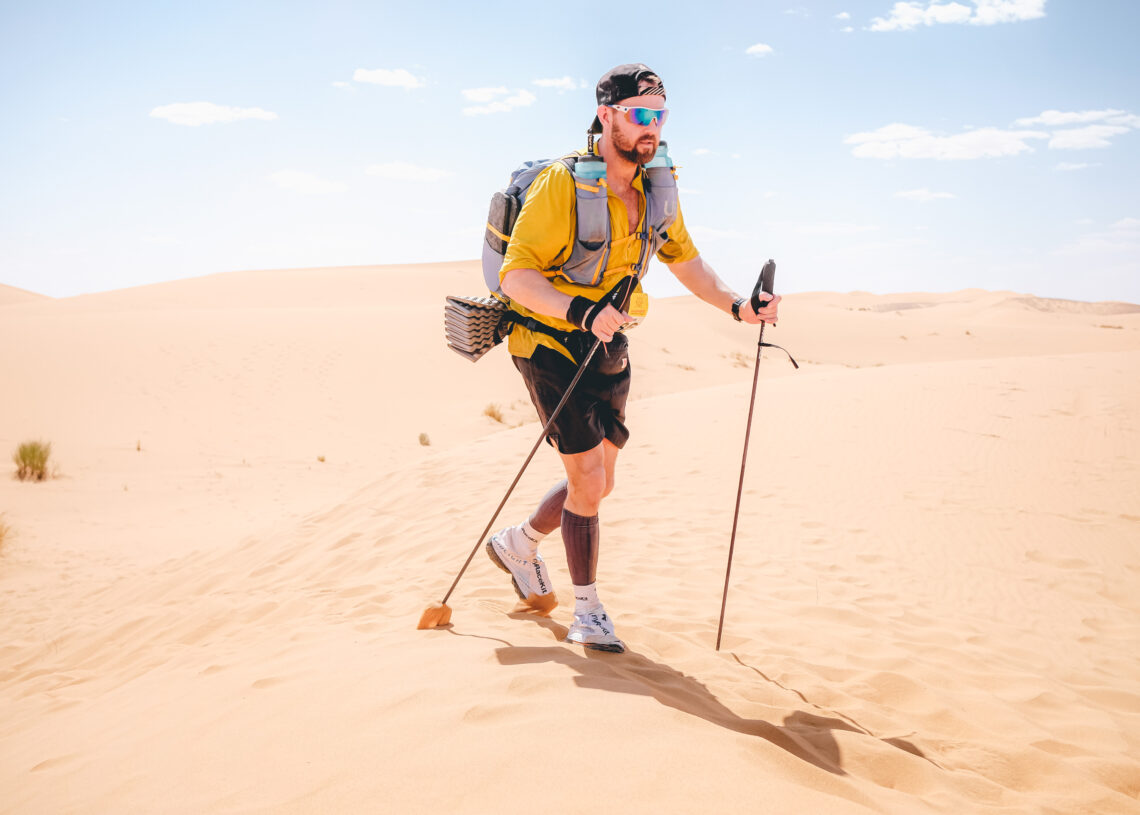
Probably the most documented horror stories of the MdS, are those of blistered feet. You might think the crux of the problem is sand, which is undoubtedly abrasive, and there’s a lot of it. But funnily enough, it isn’t. The desert-gaiter system (used by virtually everyone) does a remarkable job of keeping the sand out. On several occasions, wading through deep dunes with sand up to my knees, I remember thinking it must be getting in. Yet I would return to the tent that evening and find hardly a grain in my shoes.
Above the heat (sweat) and distance (time), the biggest issue was rocks. I had naively expected the non-dune parts of the course to be mostly flat, hard-packed ground. I had not expected the expansive stretches of jagged, rocky terrain. It felt like crossing the landscape of some other planet. My feet were working overtime, banging around relentlessly in my shoes.
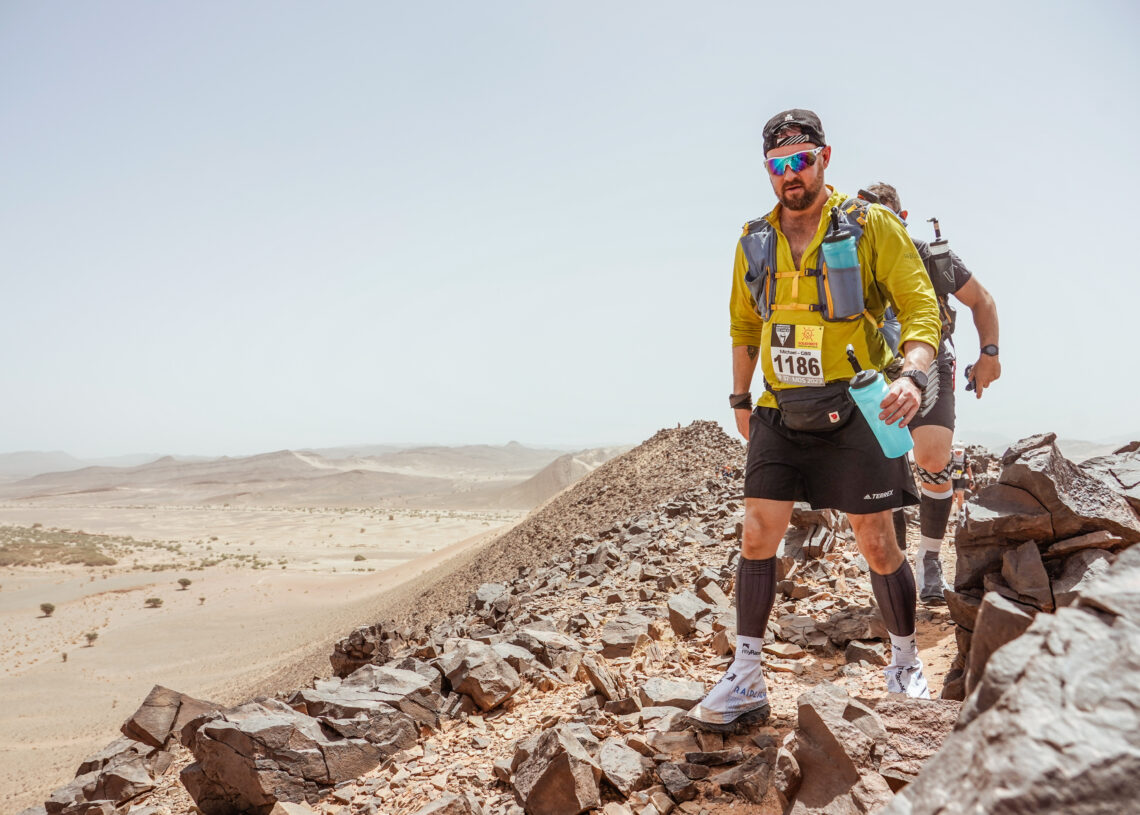
The only member of our tent to have seemingly no problems with his feet was Welshman, John, thanks to years of running over rocky trails through the Welsh hills. Like many others, whilst I was plenty fit enough going into this event, my feet were NOT adequately trained for uneven ground.
By day three, I joined the hundreds of others in the nightly routine of the blister tent (Doc Trotters). In a large tent, they had around 30 medics with racers lay on their backs in front of them, feet up, being syringed, medicated, and bandaged ready for the next day.
Unfortunately, this only really slows the decline and helps protect against infection. There is no miraculous reparation. By the end of the week, I’d counted 11 different blisters, some so large they were merging. Periodically, during a stage, I would feel the sharp tingle of a blister popping and the blood and puss seeping into my shoes. My insoles by the end of the week painted a pretty good picture.
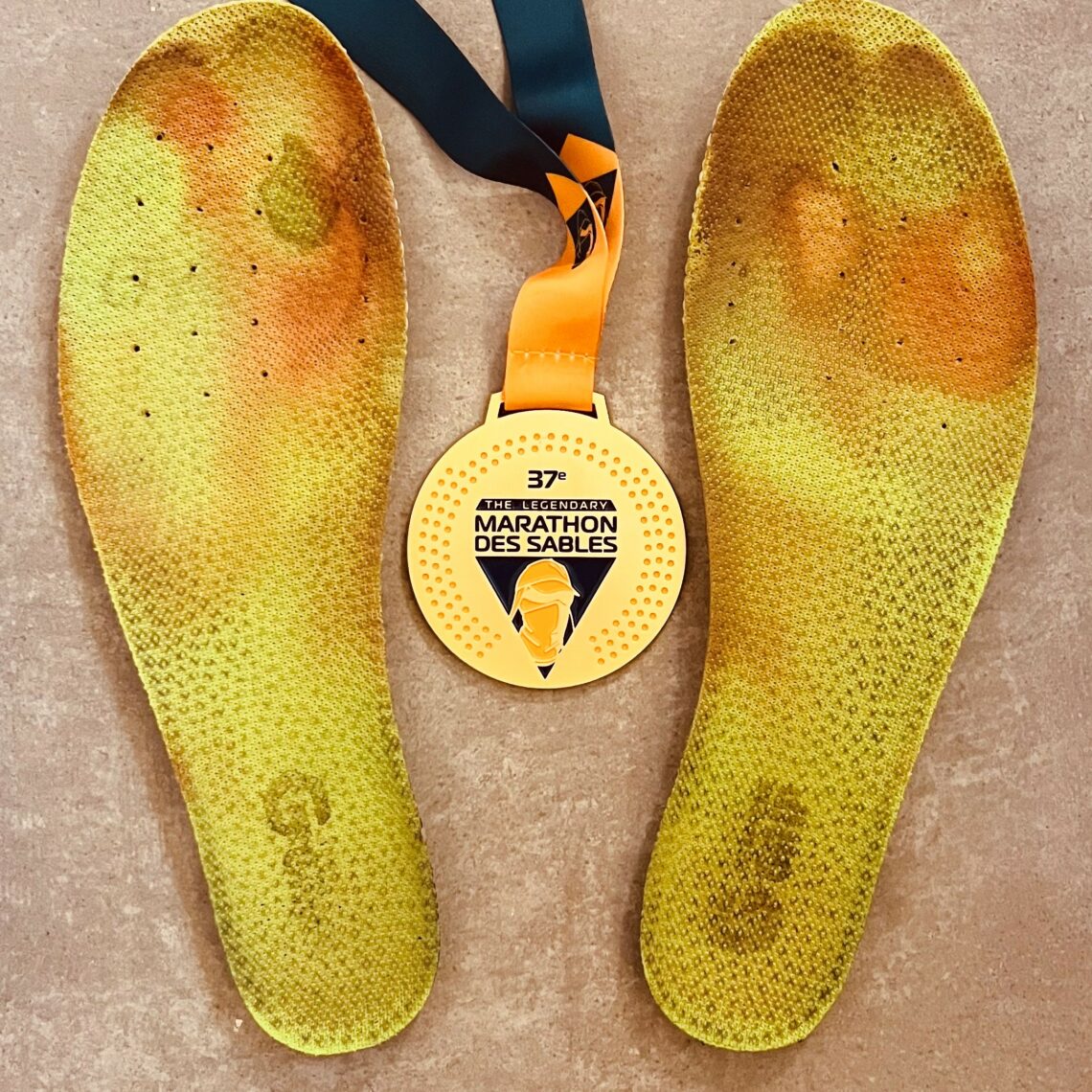
As the blisters multiplied, so did the pain. On stage three, I had still managed a respectable pace. By stage four, with 90km stretching out ahead, I was getting slower and slower. Which didn’t matter, I was only interested in finishing, except I had about another 200,000 agonising steps to get there!
Long and difficult!
I recalled the naïve conversations Tomo and I had before the race about target pacing. We’d talked about the long stage, accepting we might need to slow up, but still speculating that it would be good to finish in around 15 hours, affording a decent night’s sleep. How wrong we were!
By this point, with the shooting pains of every step, speed and targets were a pipe dream. I was operating one checkpoint at a time, and I knew I’d be out there all night.
To make matters worse, another distinct unpleasantness developed. Around 25km into the day, I felt the need to release a bit of wind, but what came out wasn’t wind! Four days of bodily deterioration, a less-than-fresh diet of freeze-dried foods and energy bars, or maybe just a bug overpowering the helpless immune system. Whatever the cause, the outcome was a disgustingly liquid affair.
I waddled off to scrub my underwear and clean my backside with a wet-wipe. At least after that I didn’t make the mistake of trying to fart again. A dozen more times that day I slinked off to the side, squatted and graced the desert with another liquid offering. I was not alone in this affliction, the effects of which provided an all-too-frequent spectacle. No racer, male or female, had the energy or inclination to stray off in search of privacy for such graphic excretions. This is a foul concept to imagine in most walks of life. Except here, in this unforgiving desert, nobody bats an eyelid.
Some 12 hours into the day, I stumbled into a checkpoint as the sun was readying to set and decided this would be a good time to briefly rest, eat some food, and set off again refreshed for my first leg into the night.
The Darkest Hour
Evening was a great time of day in the desert, when the temperature finally dips to a pleasant enough level, and the setting sun is replaced by a blanket of stars. I slouched on my pack and got out my cooking stove. I ate and whisked up a cappuccino sachet, which were one of the best items in my daily food supply – negligible calorie content, but maximum morale.
Once darkness had fallen, I donned my head torch, packed up, and began the slow process of coaxing my tortured feet back into action.
Gathering kit for this race is a process which begins months before and occupies an inordinate amount of research and deliberation. The common thread to all the advice is, minimise weight.
With the benefit of hindsight, most of my kit choices were perfectly adequate, with only a few things I might have done differently. However, at this point, my one real kit blunder came to light (or not light, as the case may be). I had selected an ‘emergency’ headtorch, on the basis that it packs down into a tiny case and weighs hardly anything. Perfect, I thought.
The route was well marked by small piles of spray-painted rocks every 100 meters or so, with reflective strips for the night. It was also simple enough to follow the stream of people, which became a string of glow sticks hooked on our daysacks, readily identifying the procession of zombies plodding into the darkness.
Unfortunately, the pitiful glow emanating from the single LED on my forehead failed miserably to illuminate the ground right in front of me, which was yet another field of small sharp rocks. They were punishing when I could see them. Not being able to, made it ten times worse.
The medical emergency aside, this first stretch into the night soon became the darkest point of the whole experience for me, literally and emotionally.
Beginning of the End
The good thing about hitting rock bottom, is the only way is up. As I limped into checkpoint five, still 30km from the stage end, I was met with a curious sight; several dozen deckchairs laid out in sociable circles. A Moroccan tea tent, which had graced the finish line of the previous stages, was there too, dishing out thimbles of super-sweet tea. There was an almost convivial atmosphere to it all.
I sank into a vacant chair, which was astonishingly comfortable under the circumstances, so I deduced a good reason to sit there a little while longer. I knew Alex could not be that far behind. I had spent the last few hours longing for some companionship to rescue me from my slump. Not to mention, someone with a working headtorch to walk alongside and see where I was stepping. Alex was the promise of exactly that. Half an hour of deckchair bliss later, he appeared.
Teamwork
Alex, although British, now lives in Australia, therefore had arrived with the Aussie contingent, who had gotten to know each other well. Alex had found himself in the company of two Aussies – Danny and Cameron – all happily maintaining a steady hiking pace. They were delighted to welcome me into their little crew.
The newfound team spirit finally began to pull me through. For periods we walked in silence, content in knowing the support was there. Sporadically, we would break into conversation, sharing our favourite jokes, films, songs, or discussing what we were looking forward to most; seeing family, a comfortable bed, shower, beer, pizza, the list went on.
We had heard a rumour about cold cans of Coke distributed at the end of the long stage. Given that every drop of liquid to have passed our lips in the past five days was insipidly hot, the simple notion of a cold drink was invigorating.
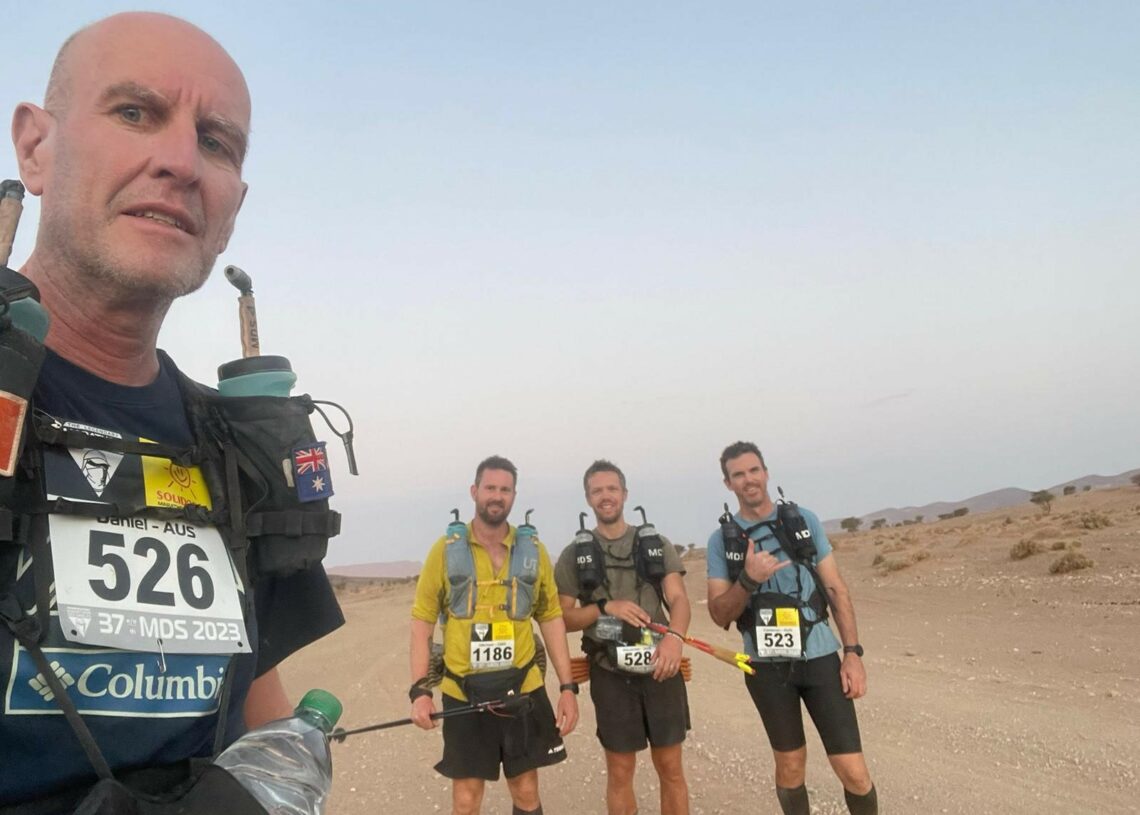
Slowly but surely our gang slogged through the night, passing the final checkpoint, 6km from the bivouac, as the sun started to rise.
We were thankful that we would be reaching camp before the mercury could rise, sparing a thought for the hundreds of participants still behind us who would soon begin to battle the searing heat yet again.
For the first time, I took note of a small camera just beyond the stage finish line, apparently broadcasting a live feed. I figured it was extremely unlikely anyone I knew would be watching. But what the hell, as I passed, I blew a kiss. I later found out my wife and kids were sat at the breakfast table watching it live. After the worry of the past few days, they were apparently overjoyed with that tiny, unexpected gesture, and relieved that I looked ‘absolutely fine’. Thankfully they didn’t know how not fine I had been!
It wasn’t over, by any stretch. There was still a full marathon stage to go, followed by the short stage to finish. But in completing the long one, we had broken the back of it. Alex and I hobbled to our tent, feeling triumphant. Unsurprisingly, John was there, but Steve was not.
The start of the long stage had been the first time when the top 50 ‘elite’ were set off hours behind the main pack. Therefore, later that day we were afforded the spectacle of watching the top runners (typically eight-stone Moroccans, highly attuned to the heat and terrain) come flying past us mere mortals. For the first three days, Steve was close behind them, and the leading Brit in the field. But on the third night he was hit with the same internal problems as me. He pleaded with the officials to let him start with the masses, knowing there was no way he could maintain his pace, but they refused.
Eventually, that afternoon, he stumbled into the tent an empty shell of his former athletic self. His first few days had been impressive, but we had even greater respect for the guts it took to overcome misfortune and simply stay in the race.
Surreal Happenings
With our remaining four finally back safely, we lay around and chatted as usual. We lamented the cold can of coke which had disappointingly failed to materialise at the line.
But then, like Manna from Heaven, late in the afternoon, a truck pulled into the centre of the bivouac filled with bins of ice and small bottles of local ‘cola’. In a scene resembling an aid truck in a refugee crisis, hundreds of dishevelled racers limped as quickly as their blistered feet could carry them to claim this modicum of cold, sugary, liquid joy.
As we savoured our treat, an even more surreal vision materialised in the large open space in the centre. They began setting up a stage and sound equipment. What transpired seemed remarkably out of place, here in this desert wilderness; an orchestra and an opera singer, apparently flown down from Paris.
The usual buzz of the bivouac fell silent as we lay under our tents, gazing out as the sun gave way to the stars, totally captivated by the melodies floating over the cool evening air. We wanted to roll our eyes at how barking mad the organisers of this event clearly were. Yet, however bizarre, it was impossible not to take in the serenity of the moment.
Finish Line (the first one)
The last meaningful stage of the race is known as the marathon stage and is always exactly 42.2km. That’s a long way under any normal circumstances. Yet, in the wake of a 90km effort, even a marathon didn’t seem that bad anymore. The recipe that had eventually dragged me through the final 30km of the long stage, remained in place. Our new team marched steadily together from the off. We chatted along the way to distract ourselves from the unrelenting pain, until, in what seemed like a blink of an eye, we set eyes on the finish line ahead.
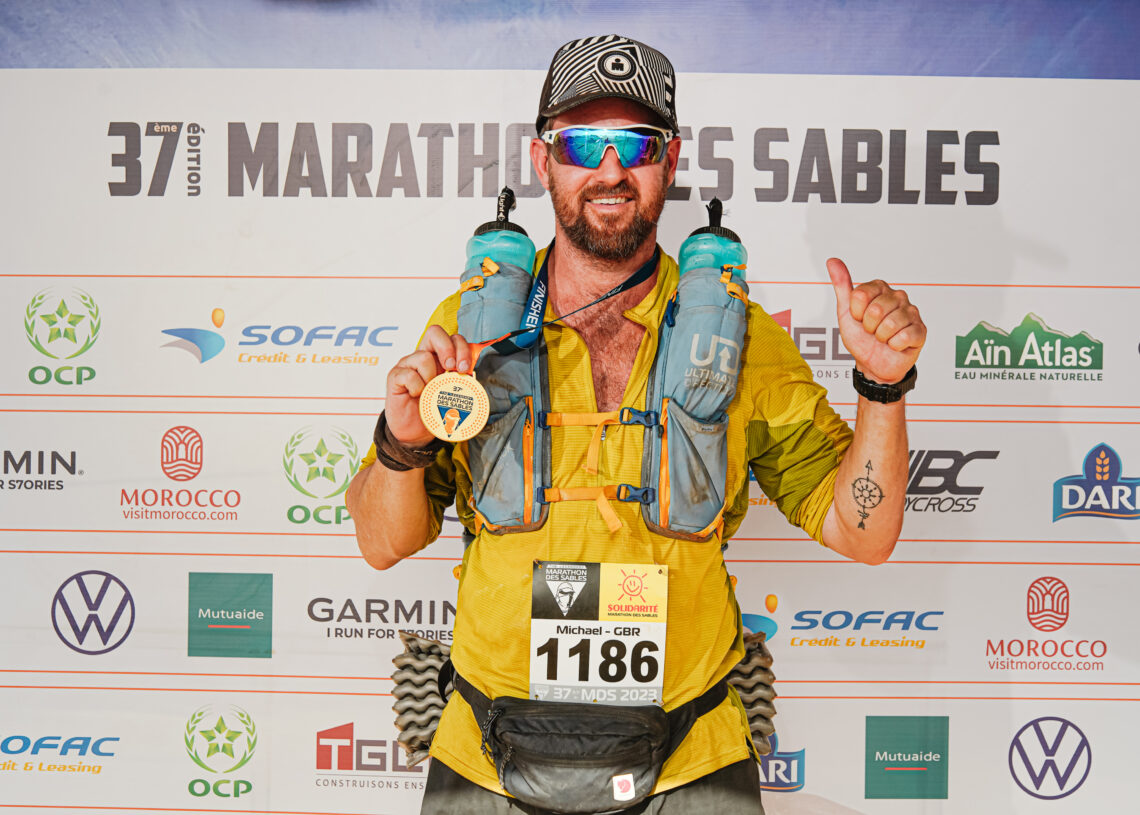
It was ambiguous to think of it as the finish line, thanks to the oddity of the race finishing twice. This was the finish of the timed section, and the point where they award your finisher’s medal. Our mood certainly reflected that. The pain almost seemed to disappear as we paced towards the line.
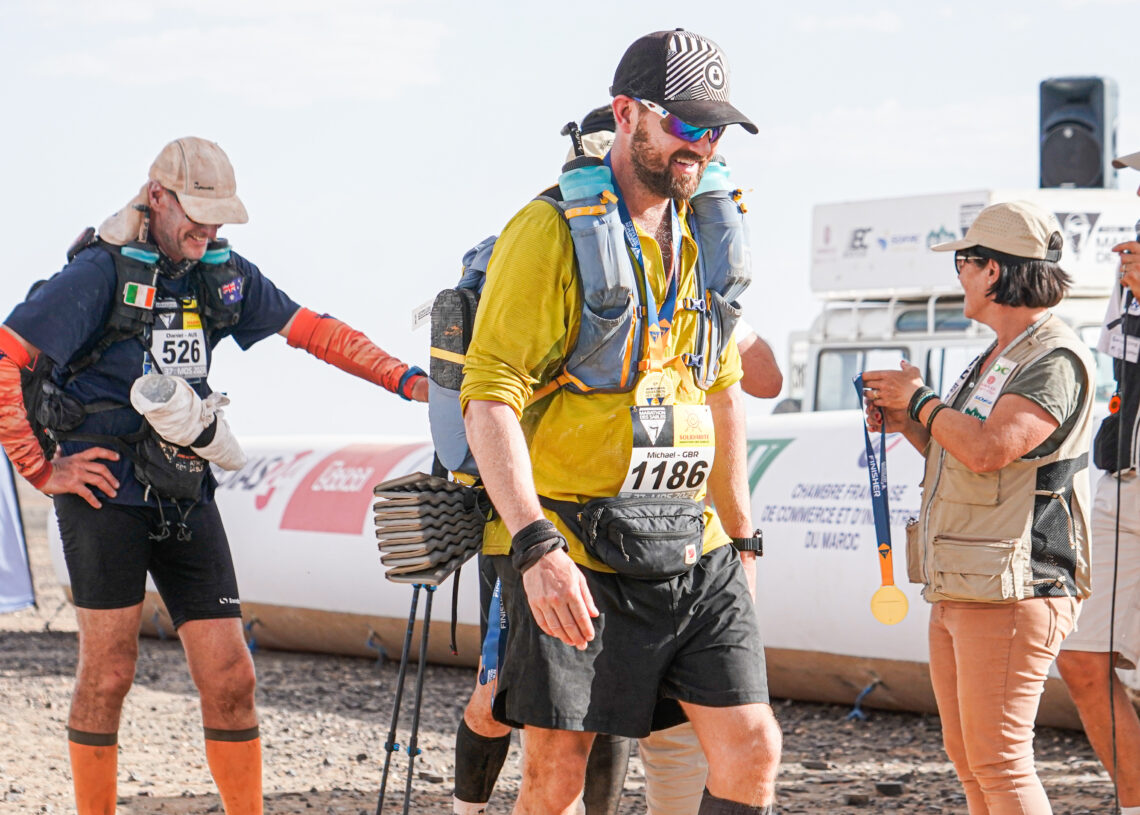
It’s no big-city marathon finish. No hordes of supporters out here in the middle of the desert cheering you on. Just a quick a medal around your neck and a photo in front of the sponsors’ board.
Placings didn’t mean much to me in my mission to finish. Although surprisingly, I still finished near the top 400 (in the top 40%), despite having dropped from the 200s to the 600s from day two’s medical stoppage. Also, having done almost no running since day one, I was definitely more tortoise than hare.
The real celebration was getting back to the tents for the final time. The entire bivouac was humming with elated finishers merrily congratulating each other on arrival. Thankfully, we returned to the customary sight of both John and Steve, waiting eagerly to celebrate with us.
Camaraderie
Whilst their abilities are impressive for sure, this race is about far more than the elite professionals. The event brings all manner of people together; young and old, from 55 different nations, with different physical abilities (and even disabilities), many striving just to complete each stage inside the cut-off times, all battling through on grit and determination. This is reflected in the heart-warming camaraderie which develops throughout the bivouac; particularly within each tent, where friends who had been strangers just days ago had become each other’s biggest fans.
This is perhaps why the final stage is what it is – short and un-timed. The whole field trundled along in a leisurely fashion, mostly in groups of tent mates. Alex, John, Steve and I strolled through the 9km of it together. I won’t pretend it was fun. In a fitting end to the event, the last 4km of it was over hideously soft sand dunes. But it was sociable at least, and 9km paled into insignificance against what had gone before.
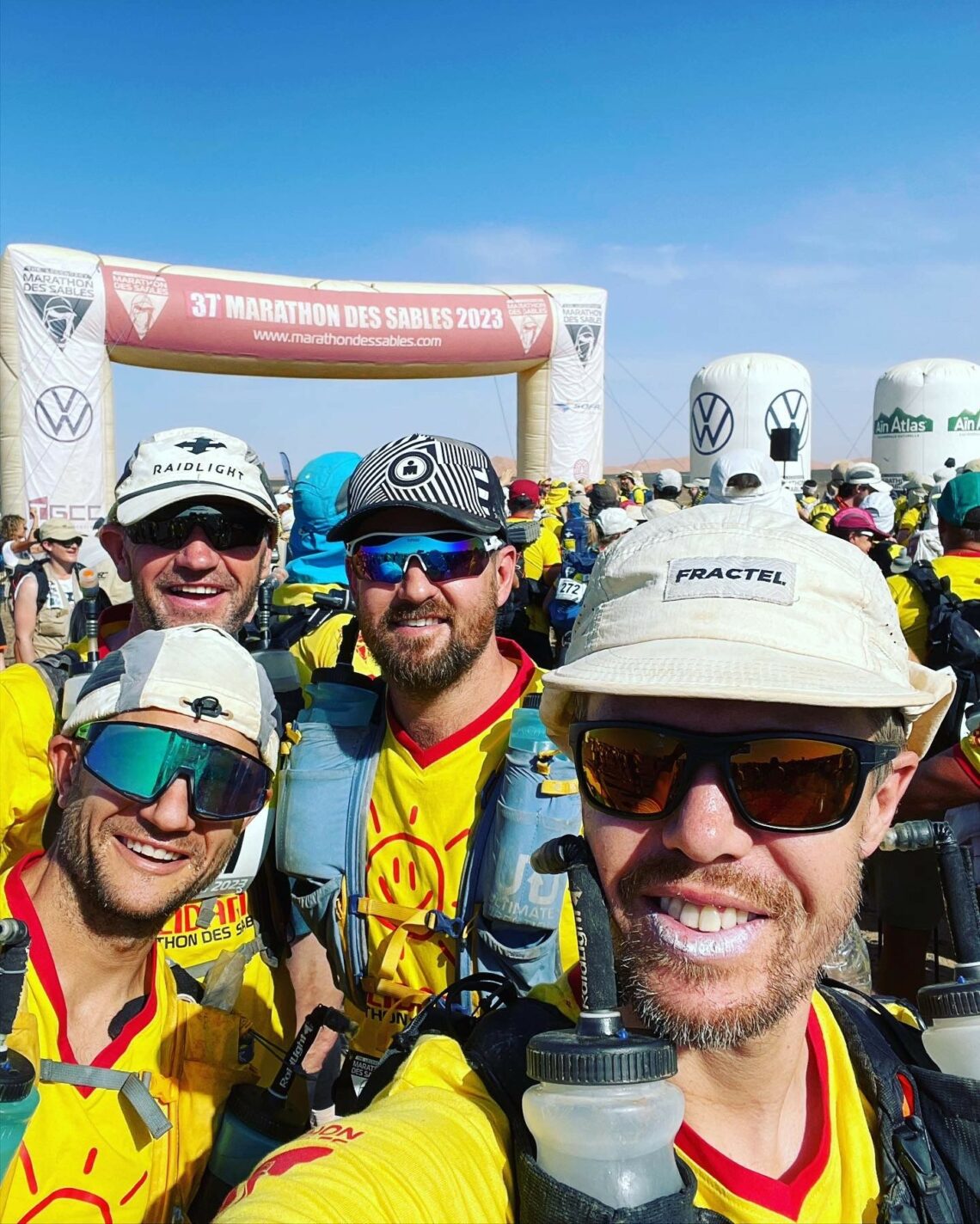
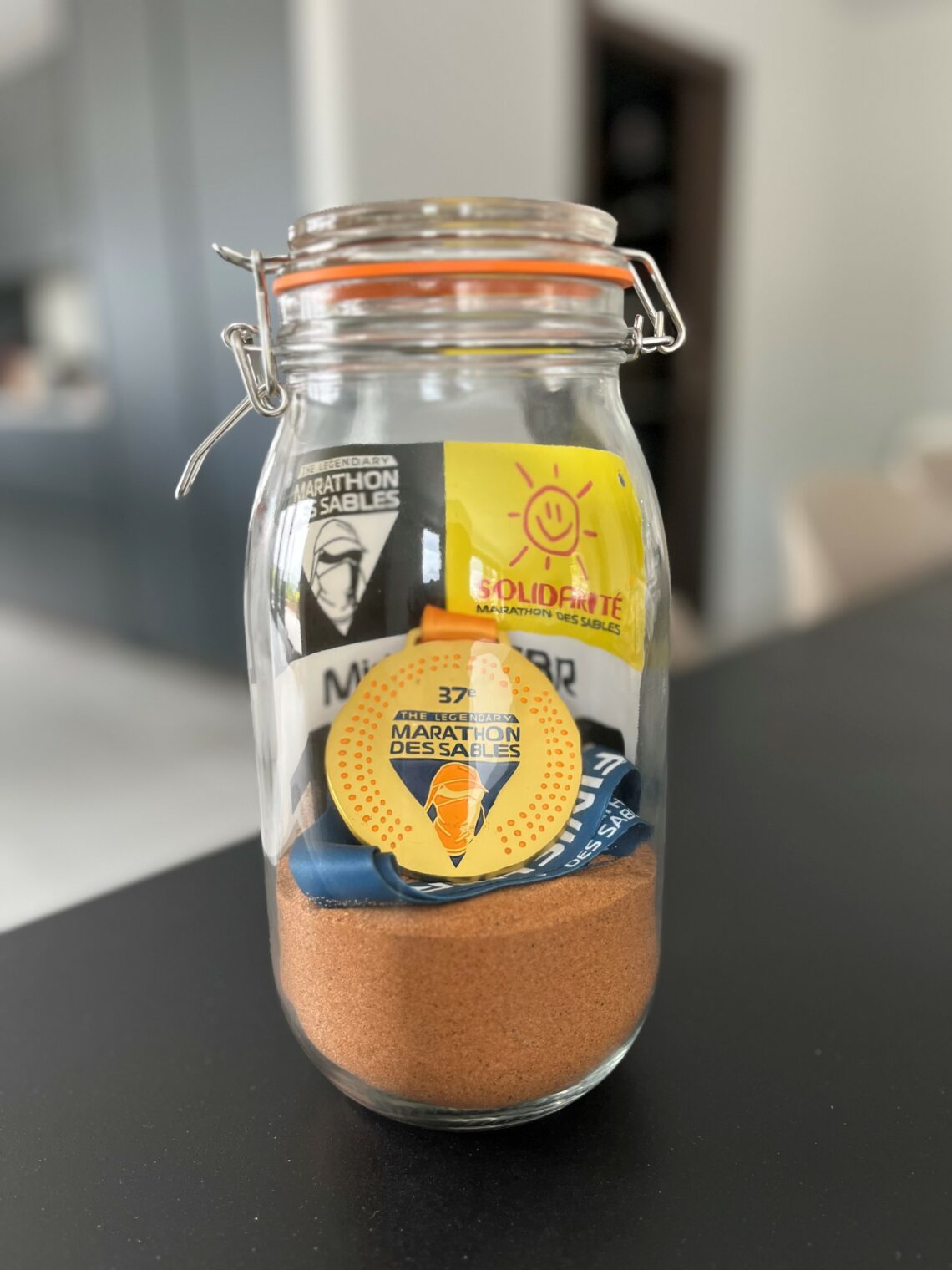
We paused just short of the line to fill an empty bottle with some Saharan sand as a souvenir, and then the four of us mustered a token burst of energy to run side by side across the line.
Peak-end Rule
As we sat by the pool the next day, laughing and drinking beer, we chatted about other extreme events on our lists.
What is it about these gruelling challenges which keeps us coming back? Why do so many people return time and time again for this one? I remembered my bewilderment in the middle of the week, pondering the sanity of the guy on his 35th MdS.
Psychologists call it the Peak-End Rule. When your brain creates memories after an event, they’re distorted by the peaks, and particularly the end, of the experience, rather than the full account of the suffering. You might remember that it hurt, but the actual feeling of it fades. Your memories become dominated by the elation of crossing the finish line, and any high points along the way.
We had been through hell and back, with no shortage of blood, sweat and tears along the way. But from those darkest hours came the slow re-emergence of pleasure, from the camaraderie to the cold cola and the bivouac opera, finishing in this lavish hotel. The whole torrid experience had somehow, cleverly, wound itself up to a tremendously positive end!


Leave a Reply


We take you to the heart of all the latest Ultra-marathons with Race Reviews from all over the UK and the World. Shining the Spotlight on Solo Adventures and Personal Journey's.